When we are going through a difficult period, the decision to seek support can raise a surprisingly complex question: should I see a psychologist or a psychotherapist? The two terms are often used as though they describe the same profession. In reality, there are important differences in these professionals’ training, competencies, and forms of intervention. At the same time, their roles can overlap because a psychologist may also complete professional training in psychotherapy. The difference between a psychologist and a psychotherapist is therefore not always apparent from a professional title alone. To make an informed choice, it is important to consider not only the title, but also the practitioner’s training, competencies, and the services they are qualified to provide.
Psychologist or psychotherapist: what is the difference?

What is a psychologist?
A psychologist is a professional who has completed university studies in psychology. This academic training provides knowledge of cognitive, emotional, and behavioural processes, human development, personality, relationships, and the mechanisms through which people adapt to different life circumstances. However, the term “psychologist” covers a broad professional field. Not all psychologists work in clinical practice, and not all provide psychotherapy. A psychologist may work in:
- clinical psychology;
- psychological counselling;
- education;
- occupational and organisational psychology;
- research;
- social services;
- educational and career guidance;
- psychological assessment.
Depending on their training and professional competencies, psychologists may conduct clinical interviews, provide counselling, perform psychological assessments and psychodiagnostic evaluations, or deliver preventive and personal-development interventions. Therefore, being a psychologist does not automatically mean that a professional is also a psychotherapist.
What is a psychotherapist?
A psychotherapist is a professional who has completed specialised training in a particular method of psychotherapy. This preparation is additional to their foundational university education and generally includes theoretical study, personal development, supervised clinical practice, and professional supervision. There are several psychotherapeutic orientations, including:
- integrative psychotherapy;
- cognitive behavioural therapy;
- psychodynamic psychotherapy;
- systemic and family psychotherapy;
- existential psychotherapy;
- person-centred psychotherapy.
Regardless of the therapeutic orientation, psychotherapy is a structured process conducted within a professional and confidential setting. It aims to help people understand and modify emotional, cognitive, behavioural, and relational patterns that cause distress or interfere with daily functioning. Depending on their competencies, psychotherapists may work with difficulties such as:
- anxiety and persistent stress;
- depressive states;
- difficulties with emotional regulation;
- traumatic experiences;
- low self-esteem;
- recurring relational conflicts and patterns;
- separation, loss, or grief;
- occupational burnout;
- life transitions and crises;
- adjustment difficulties.
Psychotherapy is neither a casual conversation nor a collection of ready-made advice. The therapeutic process involves goals, continuity, professional responsibility, and methods adapted to the individual’s needs.
Psychologist vs psychotherapist: what is the main difference?
The essential difference concerns the type of professional training and the competencies acquired.
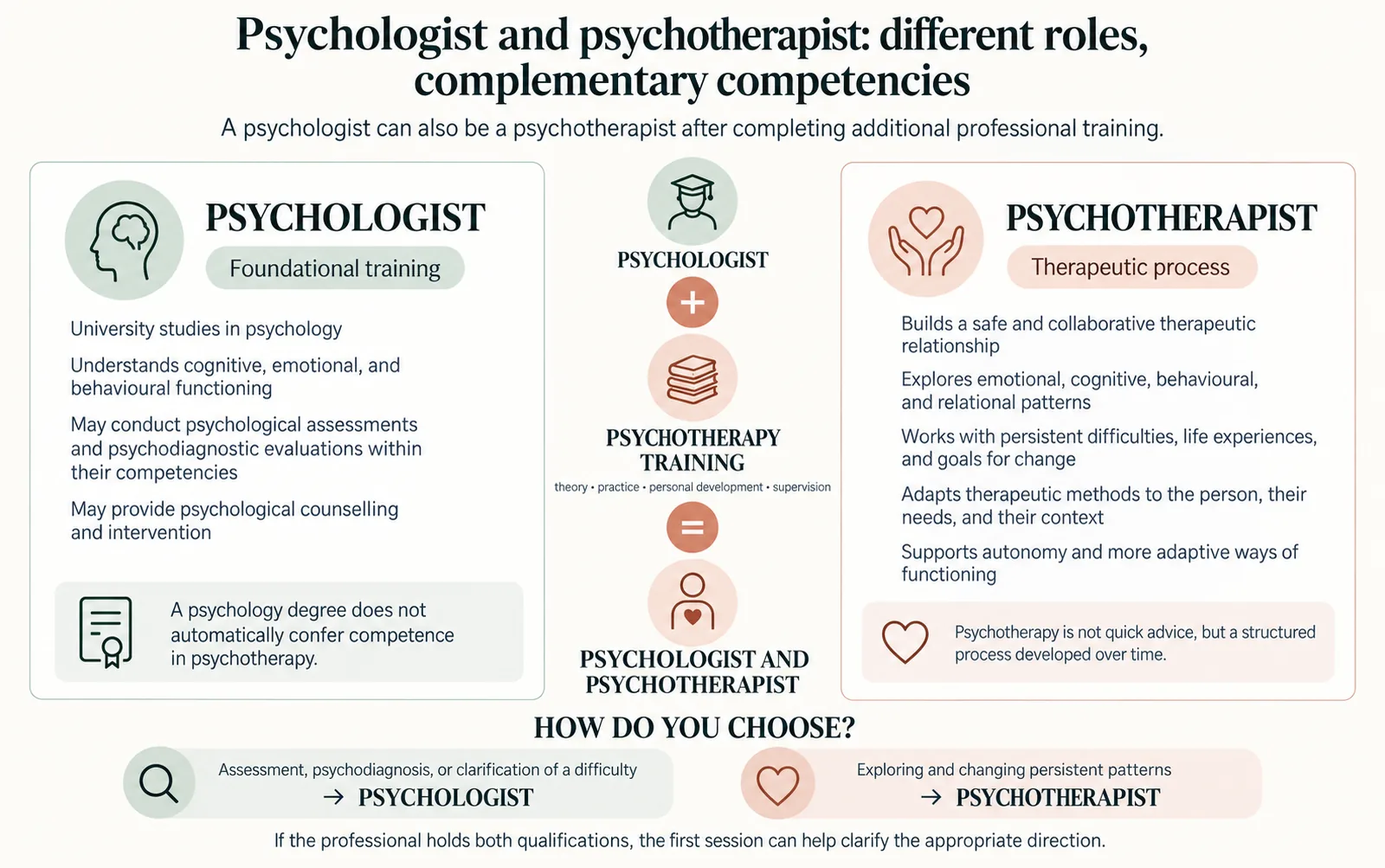
Text version of the infographic
| Psychologist | Psychotherapist |
|---|---|
| Has completed university studies in psychology | Has completed specialised training in psychotherapy |
| May work in several areas of psychology | Works through a structured psychotherapeutic process |
| May conduct psychological assessments when appropriately trained and authorised | Is not automatically qualified to perform psychological assessments solely on the basis of psychotherapy training |
| Is not automatically qualified to provide psychotherapy | Is trained in a particular psychotherapeutic approach |
| May or may not also be a psychotherapist | Depending on their professional pathway and the applicable regulatory framework, may have a foundational background in psychology, medicine, or a related field |
In practice, the same person may hold both qualifications. A psychologist and psychotherapist can combine a psychological understanding of human functioning with methods specific to psychotherapeutic intervention. The question should therefore not be limited to “Are they a psychologist or a psychotherapist?” It is equally important to ask: What training have they completed, and is it appropriate for the difficulty I am experiencing?
When should you see a psychologist?
You may consider consulting a psychologist when you need:
- an assessment of emotional, cognitive, or behavioural functioning;
- a personality assessment;
- psychodiagnostic evaluation;
- psychological counselling for a specific difficulty;
- career counselling and support with professional decision-making;
- an assessment of a child’s or adolescent’s development;
- psychological recommendations based on an assessment;
- clarification of a situation before deciding whether psychotherapy may be appropriate.
For example, a parent may request a psychological assessment after noticing persistent changes in their child’s behaviour, difficulties adjusting to school, emotional concerns, or declining academic performance. An adult may consult a psychologist for a personality assessment, help clarifying a career decision, or a better understanding of emotional difficulties. An assessment is not an examination that you must “pass.” Its purpose is to provide a clearer picture of psychological functioning and support the formulation of appropriate recommendations.
When should you see a psychotherapist?
Psychotherapy may be appropriate when a difficulty is not merely temporary, or when you notice that certain emotional states and patterns continue to recur. You might consider psychotherapy if:
- anxiety affects your choices and everyday activities;
- you frequently experience self-criticism, guilt, or insecurity;
- you repeat the same relational patterns despite wanting different outcomes;
- you find it difficult to establish or maintain boundaries;
- you are going through a separation, loss, or significant life change;
- your emotions feel overwhelming or, conversely, you feel disconnected from them;
- you experience difficulties in your relationship with yourself or with others;
- strategies that helped you in the past no longer seem effective;
- you want to understand more deeply how earlier experiences influence your present life.
You do not need to reach a point of crisis before beginning psychotherapy. Some people seek support not because they “cannot cope anymore,” but because they no longer want to continue in the same way.
Can a psychologist and a psychotherapist be the same person?
Yes. A psychologist can become a psychotherapist by completing additional professional training and meeting the requirements associated with psychotherapeutic practice. In this case, the practitioner has both academic training in psychology and specialised training in a particular method of psychotherapy. The two qualifications nevertheless remain distinct: a psychology degree does not replace psychotherapy training, just as psychotherapy training does not automatically confer all the competencies of a psychologist. When choosing a specialist, consider checking:
- their foundational education;
- their psychotherapy training;
- professional accreditation or right to practise;
- experience relevant to your concern;
- participation in professional supervision;
- the populations they work with: adults, children, adolescents, couples, or families;
- their professional framework, including confidentiality and the duration and frequency of sessions.
Does this seem like a great deal of research for a conversation? Perhaps. Yet when psychological health is concerned, a persuasive social-media description should not replace verifiable professional training.
What is the difference between a psychotherapist and a psychiatrist?
A psychiatrist is a medical doctor specialising in psychiatry. Psychiatrists can assess mental health conditions from a medical perspective, formulate psychiatric diagnoses, and prescribe medication. Psychologists and psychotherapists do not prescribe medication, apart from limited exceptions in certain legal systems that do not represent the general rule. In some cases, psychotherapy and psychiatric treatment may be recommended together. These forms of intervention are not mutually exclusive and should not be regarded as competing alternatives. Interdisciplinary collaboration may be particularly important when emotional difficulties are severe, persistent, or significantly interfere with everyday functioning.
How do you choose the right professional?
A professional title matters, but it should not be the only criterion. An informed choice involves considering both the specialist’s qualifications and the compatibility between your needs and the services they provide.
1. Clarify why you are seeking support
Do you need an assessment, counselling for a specific situation, or a more in-depth psychotherapeutic process? You do not need to have a perfect answer before the first meeting, but an honest description of your difficulty can help the professional determine whether they are able to support you.
2. Check their professional training
Look for clear information about education, specialised training, accreditation, and experience. Phrases such as “emotional healing expert” may sound impressive, but they do not constitute a professional qualification in themselves.
3. Notice how the services are presented
A responsible practitioner communicates the limits of their competencies, does not guarantee results, and does not promise instant transformation. Psychotherapy can support meaningful change, but it does not operate like a premium subscription to a life without difficulties.
4. Pay attention to the therapeutic relationship
It is important to feel heard, respected, and sufficiently safe to speak honestly. A constructive therapeutic relationship does not mean that every session will feel comfortable; rather, it means that difficult subjects can be explored within a professional, non-judgemental setting.
5. Ask questions
You may ask the specialist about:
- their training and therapeutic orientation;
- their experience with similar difficulties;
- how sessions are structured;
- confidentiality;
- the recommended frequency of sessions;
- the boundaries of the therapeutic work;
- the procedure followed in emergency situations.
A competent professional should not feel threatened by reasonable questions about their training.
Is a psychologist or a psychotherapist more appropriate for anxiety?
The answer depends on the intensity, duration, and impact of anxiety on your life. A psychologist with clinical training can assess the symptoms and the ways in which they affect your functioning. A psychotherapist can work systematically with the mechanisms that maintain anxiety, such as avoidance, negative anticipation, an excessive need for control, or interpreting situations as threatening. If the symptoms are intense, include frequent panic attacks, or affect sleep, eating, or your ability to function, a psychiatric evaluation may also be recommended.
Do I need a diagnosis to attend psychotherapy?
No. Psychotherapy is not reserved for people who have received a diagnosis. You may seek support for relational difficulties, stress, burnout, self-understanding, professional transitions, adjustment difficulties, or a persistent sense of dissatisfaction that you cannot yet explain clearly. Sometimes the first objective of therapy is precisely to formulate and understand the problem. You do not need to arrive with a perfect explanation; it is enough to notice that something concerns you, affects you, or continues to repeat itself.
Psychologist or psychotherapist: whom should you ultimately choose?
Choose a psychologist when you primarily need a psychological assessment, psychodiagnostic evaluation, counselling, or clarification of a specific difficulty. Choose a psychotherapist when you are looking for a therapeutic process focused on understanding and changing emotional, behavioural, or relational patterns. If the specialist is both a psychologist and a psychotherapist, they can explore with you which service best corresponds to your needs. What matters is that the professional role and the purpose of the work are clearly explained from the beginning.
Rather than a conclusion
The difference between a psychologist and a psychotherapist does not determine which professional is “better.” It indicates that they have different forms of training and competencies, and that the appropriate choice depends on the type of support you need. Beyond the title itself, what matters is the practitioner’s actual training, experience, respect for professional boundaries, and the quality of the relationship established with the person seeking support. If you are still uncertain about which form of support may be appropriate, that is entirely understandable. Clarifying your needs can begin during the first session.
I provide psychology and psychotherapy services in my office in Chișinău and online. For information about the available services and appointments, please consult the dedicated pages on this website.