When you begin looking for a psychotherapist, you may encounter a long list of approaches: cognitive behavioural, psychodynamic, humanistic, existential, systemic, integrative, and many others. For someone who does not work in psychology, all these terms can prompt a perfectly reasonable question: Do I need to understand the different forms of psychotherapy before choosing a therapist? Not necessarily. It is useful, however, to understand how a prospective therapist works and how they adapt the therapeutic process to your difficulties, goals, circumstances, and individual characteristics. One of the approaches you may encounter is integrative psychotherapy. At its core, integrative psychotherapy begins with the recognition that a person's psychological experience may be too complex to be understood adequately through a single therapeutic perspective. A person is not merely the sum of their thoughts. Nor are they simply the product of their past, emotions, behaviours, or relationships. All these dimensions influence one another. Therapy may therefore need to consider them together.
Integrative Psychotherapy: What It Is, How It Works, and Whether It May Be Right for You

What is integrative psychotherapy?
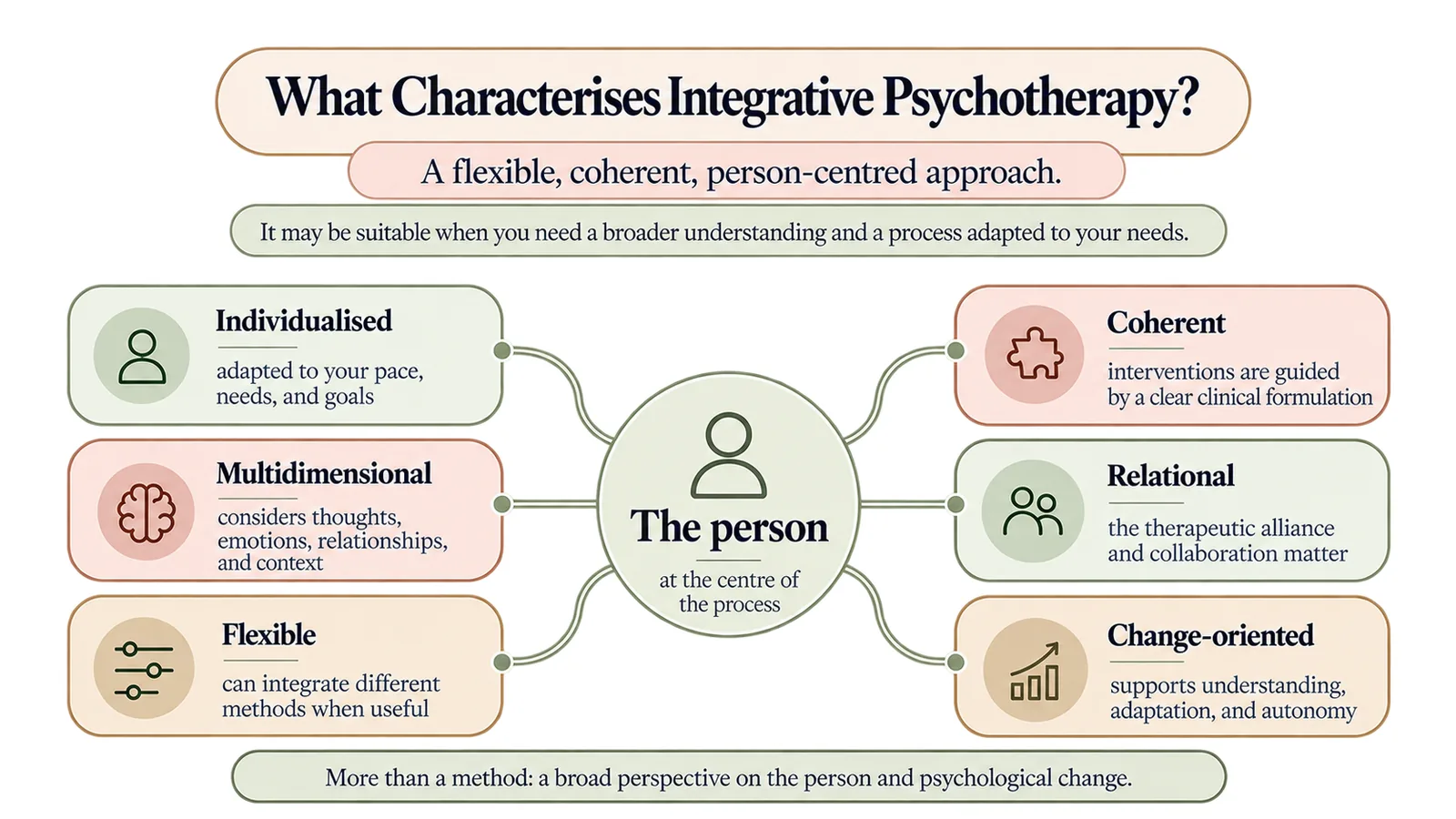
Integrative psychotherapy brings together concepts, theoretical models, and interventions from more than one psychotherapeutic orientation within a coherent clinical framework. The APA Dictionary of Psychology describes it as psychotherapy that selects theoretical models or techniques from different therapeutic schools according to a client's particular difficulties. Similarly, the European Association of Integrative Psychotherapy presents it as a multidimensional approach that responds to the person across emotional, cognitive, behavioural, physiological, relational, and other relevant levels of experience. Its central idea can be expressed quite simply: therapy is adapted to the person, rather than requiring the person to fit a rigid therapeutic method. This does not mean that a therapist randomly uses "a little bit of everything." Integration requires a coherent psychological formulation: an informed understanding of what is happening, how the difficulty may have developed, what maintains it in the present, which resources are available, and what form of intervention may be appropriate. The professional literature describes several routes to integration in psychotherapy—from combining theories and techniques to identifying mechanisms of change shared across different therapeutic orientations.
What does "integrative" mean in therapeutic practice?
Imagine that two people come to therapy saying the same thing: "I feel very anxious." At first glance, their difficulties may appear identical. In reality, their experiences may be quite different. For one person, anxiety may be connected primarily to anticipating negative scenarios and feeling compelled to maintain control. For another, it may emerge most strongly in relationships whenever rejection or abandonment seems possible. A third person may experience anxiety mainly in professional situations, interpreting every mistake as evidence of personal inadequacy. The symptom may carry the same label. The psychological mechanisms beneath it may nevertheless be different. An integrative therapeutic process may therefore consider several dimensions of psychological functioning:
- Thoughts and personal interpretations. How do you interpret what is happening? What assumptions do you make about yourself, other people, and the future?
- Emotions. What are you feeling? Which emotions are difficult to recognise, tolerate, or express?
- Behaviours. What do you do when discomfort appears? Do you avoid, withdraw, seek reassurance, work excessively, or attempt to control the situation?
- Relationships. Do certain patterns recur in close relationships? How do you respond to intimacy, conflict, criticism, or distance?
- Earlier experiences. Have particular experiences contributed to the development of certain beliefs, protective strategies, or ways of relating?
- Current context. What is happening in your life now? Relationships, work, family, health, social circumstances, and significant transitions may all play an important role.
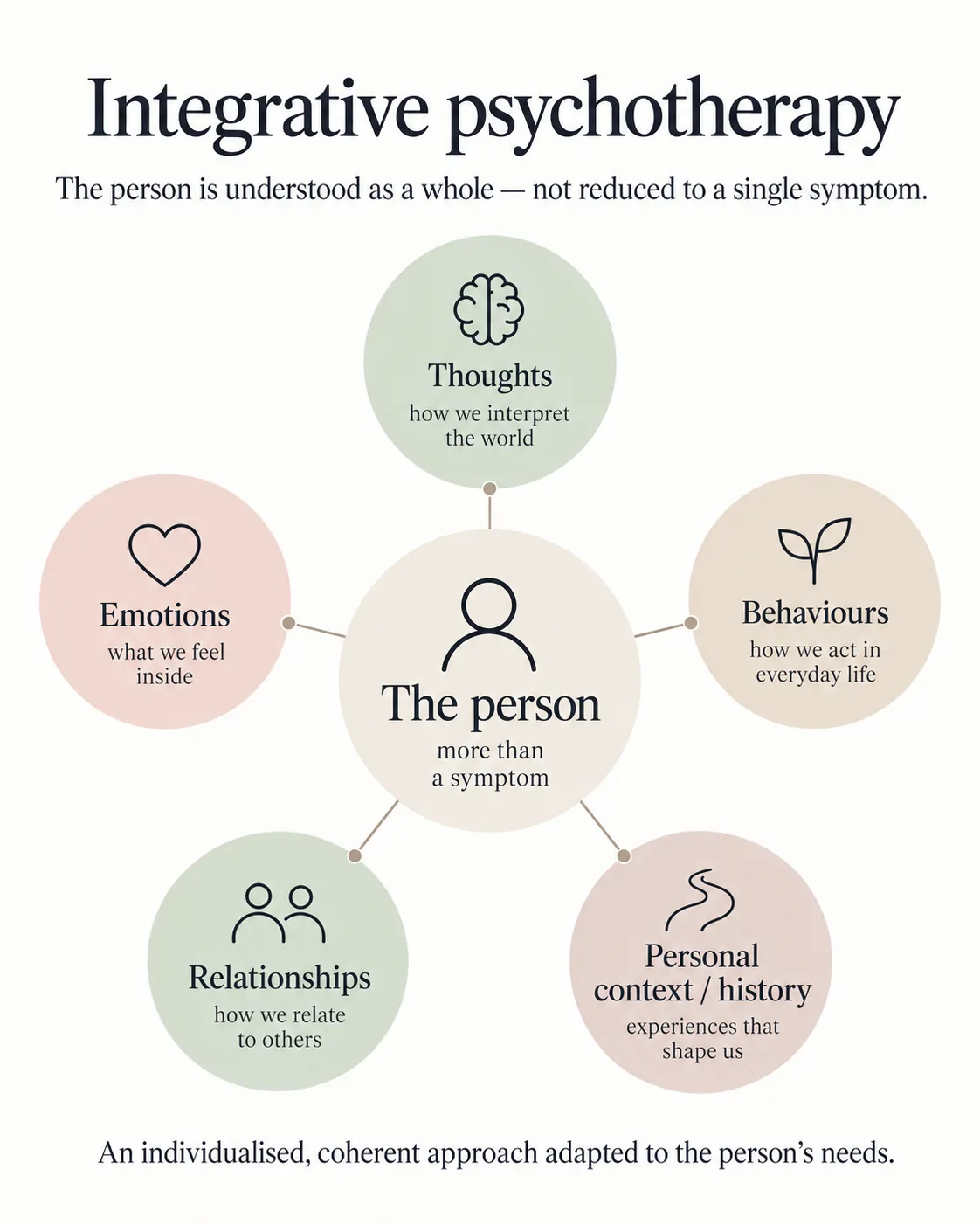
Integrative psychotherapy seeks to understand the connections among these dimensions rather than treating each one in isolation.
Does integrative psychotherapy mean that the therapist uses any technique?
No. This is perhaps one of the most important distinctions. Integration is not improvisation. There is a meaningful difference between the deliberate, clinically grounded use of concepts and interventions from several orientations and the application of disconnected techniques without a coherent rationale. Any therapeutic intervention should answer a question: Why are we doing this, and what are we trying to understand or change through it? At times, it may be useful to work with particular thoughts and interpretations. At other times, it may be more important to notice an emotion that has long been avoided. The process may also focus on personal boundaries, relationships, earlier experiences, emotional regulation, or behaviours that maintain the current difficulty. Integration allows for this flexibility, but the work should remain coherent, clinically reasoned, and responsive to the person.
What might the process of integrative psychotherapy look like?
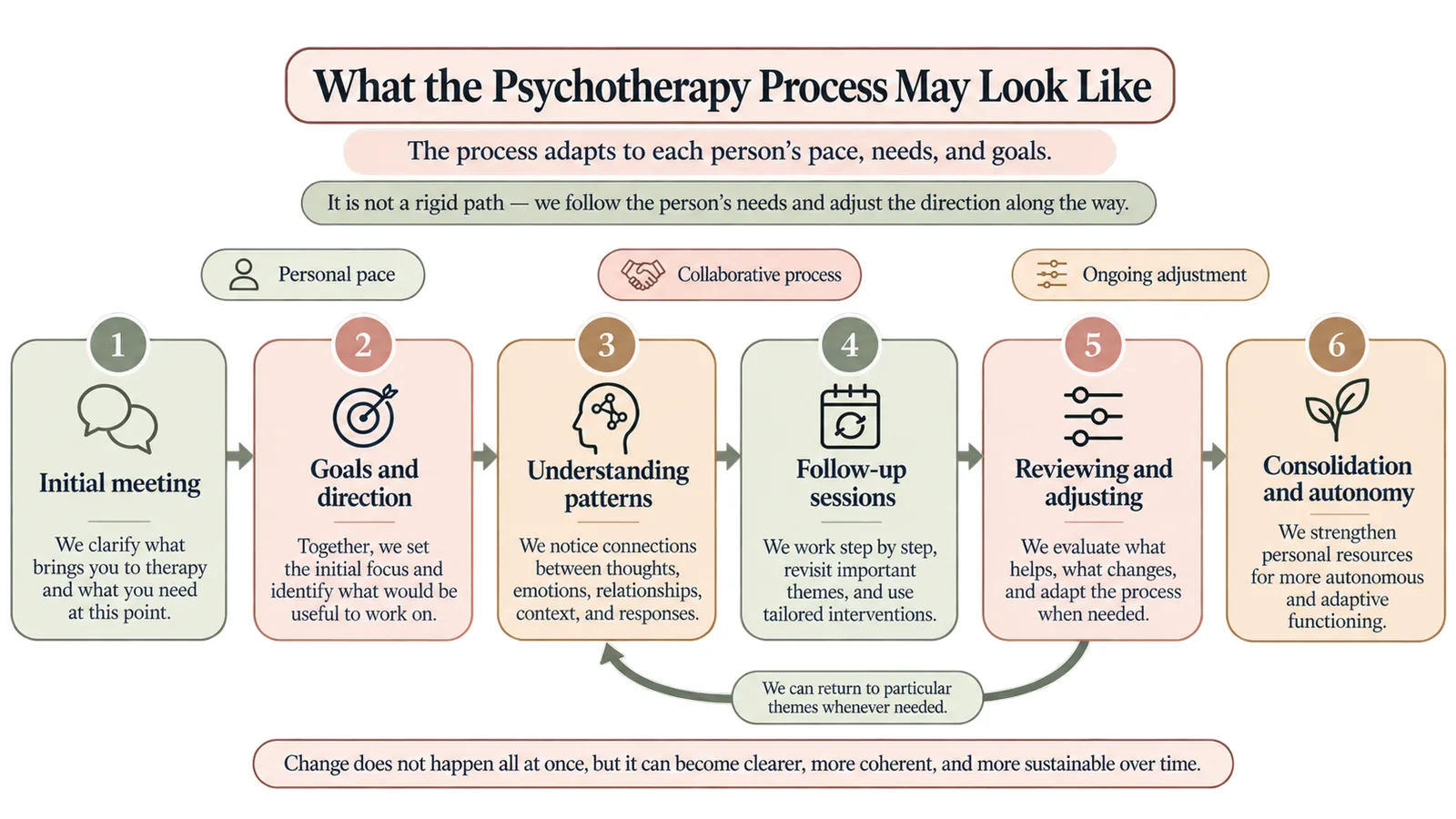
No two therapeutic processes are exactly alike. There are, however, several broad stages that may be present.
Understanding what brings you to therapy
The first sessions are not usually about discovering a miraculous solution. They are primarily about understanding. What has led you to seek support at this particular point? Which difficulty affects you most? How long has it been present? In which situations does it appear? What have you tried so far? What would you like to be different? Some people begin therapy with a very specific goal. Others arrive with little more than the feeling: "I do not know exactly what is happening, but something does not feel right." That is also a completely legitimate starting point.
Identifying patterns
As the conversations develop, connections among situations, thoughts, emotions, behaviours, and relationships may become more visible. Perhaps you withdraw whenever conflict appears. Perhaps you feel that you must remain productive in order to have value. You may agree to things you do not want because you are afraid of disappointing someone. Or perhaps the same fear appears across different relationships, even when the people around you change. At this stage, therapy begins to move from: "What is happening to me?" to: "How does this pattern operate, and why does it continue to repeat itself?"
Working with the mechanisms that maintain the difficulty
Depending on what becomes relevant, the process may involve exploration, reflection, psychoeducation, between-session exercises, attention to emotional responses, behavioural change, or work with recurring relational patterns. The goal is not to use as many techniques as possible. The goal is to select interventions that make sense for the difficulty, the current stage of therapy, and the individual person.
Developing alternatives
Understanding is important, but psychotherapy does not end with "now I know why I do this." An essential part of the process is developing different ways of responding. You may begin to notice what you feel earlier. You may set a boundary before reaching exhaustion. You may learn to tolerate uncertainty without checking the same thing ten times. You may express a need without automatically assuming that you will be rejected. You may become better able to distinguish what is happening now from what you learned to expect would happen. Gradually, what was initially explored in the therapy room can become a capacity you use independently in everyday life.
Does integrative psychotherapy focus only on the past?
No. The past becomes relevant when it helps us understand the present. Therapy does not necessarily involve analysing every part of your childhood, nor does every present difficulty need to be explained through a past event. Sometimes it is important to understand where a particular pattern originated. At other times, it is more useful to examine what maintains it today. For example, having once learned to avoid conflict may help explain why saying "no" is difficult. Change, however, also requires learning how to establish boundaries in your current relationships. Within an integrative approach, the past and the present do not need to compete for attention. A more helpful question is: What do we need to understand so that things can work differently now?
What difficulties can integrative psychotherapy address?
People seek psychotherapy for many different reasons, including:
- anxiety, persistent worry, or tension;
- stress and feeling overwhelmed;
- periods of exhaustion or burnout;
- emotional difficulties or low mood;
- difficulties in intimate, family, or professional relationships;
- fragile self-esteem;
- difficulties with emotional regulation;
- significant life transitions;
- difficulty making decisions;
- recurring relational or behavioural patterns;
- a wish for greater self-understanding and personal development.
On my Individual Psychotherapy for Adults page, these areas are approached through a process adapted to each person's history, current difficulties, and therapeutic goals. It is important to remember that the same broad category of difficulty does not automatically require the same intervention for every person.
Does my problem need to be "serious enough" before I begin therapy?
There is no universal threshold you must cross before you are "allowed" to seek therapy. Some people seek support during a crisis. Others come because they notice that the same difficulty keeps returning. Some want to manage anxiety or relationships more effectively. Others appear to function well but realise how much effort it takes to maintain that equilibrium. You can also begin therapy with questions such as: Why do I react so strongly in certain situations? Why do I keep repeating the same kind of relationship? Why is it so difficult for me to say no? Why do I feel guilty when I prioritise my own needs? Why do I continue to feel uneasy even when, objectively, things are going well? Psychotherapy is not reserved exclusively for moments of crisis. It can help a person recognise difficulties earlier, strengthen psychological resources, and interrupt the consolidation of unhelpful patterns—a perspective also reflected in the services presented on this website.
How long does integrative psychotherapy take?
One of the most natural questions when beginning therapy is: "How many sessions will I need?" Unfortunately—or perhaps fortunately—the human mind does not come with a progress indicator displaying "63% complete." The duration of psychotherapy depends on several factors:
- the nature of the difficulty;
- how long it has been present;
- the goals of therapy;
- the complexity of the situation;
- the person's individual pace;
- the resources available;
- what emerges and changes during the process.
A recent and clearly defined difficulty may require a different process from a relational pattern that has been present for many years. For this reason, it is generally more useful to discuss and review duration as therapy develops than to determine it artificially before the therapist has understood the situation.
Does the relationship with the therapist matter?
Yes—and not only intuitively. Psychotherapy research consistently identifies an association between the quality of the therapeutic alliance and therapeutic outcomes. A large meta-analysis by Flückiger and colleagues included 295 independent studies and more than 30,000 clients. It found a robust positive relationship between the therapeutic alliance and psychotherapy outcomes across different treatment approaches, client characteristics, and countries. The finding represents an association and should not be interpreted as a simple guarantee of causation. Read the study summary on PubMed or access the article through its DOI. The therapeutic alliance is not simply a matter of liking your therapist. Among other things, it involves:
- experiencing enough safety to speak openly;
- feeling that your experience is taken seriously;
- developing a shared understanding of therapeutic goals;
- generally understanding the direction of the work;
- being able to say when something does not feel suitable;
- having your boundaries respected;
- participating in a collaborative relationship rather than one in which the therapist claims to "know who you are better than you do."
Therapy brings together the therapist's professional expertise and your expertise in your own lived experience. The process is constructed between the two.
How can you tell whether a therapist and their approach are right for you?
You do not need to know after the first meeting that you have found the right therapist. The opening sessions also give you an opportunity to observe how you experience the process. You may find it helpful to ask yourself:
- Do I feel listened to, or merely analysed?
- Can I ask questions about what we are doing?
- Can the therapist explain how they work?
- Do I feel that my goals are being considered?
- Are there clear professional boundaries and a clear therapeutic framework?
- Can I disagree or say that something is not working for me?
- Am I beginning to understand my experience more clearly?
A therapist does not need to agree with you at all times, and therapy does not need to feel comfortable in every moment. The process sometimes involves engaging with difficult material. There is, however, an important difference between the understandable discomfort of psychological exploration and a persistent sense that you are not being respected, heard, or kept safe within the therapeutic relationship.
What can you ask a psychotherapist before or at the beginning of therapy?
It is entirely reasonable to ask how someone works before entrusting them with highly personal aspects of your life. For example:
- What training do you have in psychotherapy?
- How would you describe your therapeutic approach?
- Do you have experience working with the difficulty for which I am seeking support?
- What usually happens during the first session?
- How will we establish the goals of therapy?
- How will we know whether the process is helping?
- What happens if I feel that a particular intervention does not suit me?
A professional should be able to discuss these matters transparently.
What psychotherapy should not promise
Regardless of the therapeutic orientation, it is worth approaching spectacular promises with a degree of caution. Psychotherapy cannot guarantee that: "your anxiety will disappear in three sessions"; "you will never experience negative emotions again"; "you will discover the exact cause of every problem"; or that one universal technique will work identically for everyone. Psychological change is usually less cinematic. Sometimes it appears in a new observation. In recognising a pattern slightly earlier. In a conversation in which you set a boundary for the first time. In responding to a situation in a way you previously did not believe was possible. In being able to tolerate an emotion without immediately trying to escape it. Taken separately, these changes may appear small. Together, they can significantly alter how a person functions and relates to their experience.
Integrative psychotherapy: an approach adapted to the person
Perhaps the simplest way to understand integrative psychotherapy is this: it does not attempt to reduce a person to a single explanation. Thoughts matter. Emotions matter. Relationships matter. Earlier experiences may matter. Current behaviours matter. The context in which you live matters. The importance of each of these elements may differ from one person to another—and even from one stage of therapy to another. For this reason, the central question in an integrative process is not merely: "Which technique can we use?" It is first: "What is happening for this person, and what do they need at this point?" From here, a therapeutic process can begin that seeks not only to reduce a symptom but also to develop a deeper understanding of how you think, feel, relate, and respond—alongside more adaptive ways of engaging with your experiences.
Are you considering psychotherapy?
You do not need to arrive at the first session with a perfectly formulated explanation of what is happening. You may begin simply with: "I am not entirely sure what I need, but I would like to understand more clearly what is happening." Clarification is part of the process. In my practice, individual psychotherapy for adults is provided within a confidential and personalised framework, either online or in person in Chișinău. Sessions last 50 minutes, and the process is adapted to each person's current difficulties, personal history, and therapeutic goals. Sometimes the first step in therapy is not knowing exactly what needs to change. It is beginning to understand more clearly what is happening.
Professional sources
- APA Dictionary of Psychology — Integrative psychotherapy
- European Association of Integrative Psychotherapy — Integrative psychotherapy
- Flückiger, Del Re, Wampold & Horvath (2018) — The alliance in adult psychotherapy: A meta-analytic synthesis
This article is intended for general informational and psychoeducational purposes. It does not provide a diagnosis and cannot replace individual psychological, psychiatric, or medical assessment.